
12 Dark Academia Pixel Art Ideas for Cozy Coloring
Try twelve bookish pixel art prompts, from lamplit desks to rainy bookshops, with advice on keeping dark scenes clear enough to color.
By Paweł Tymczuk ·
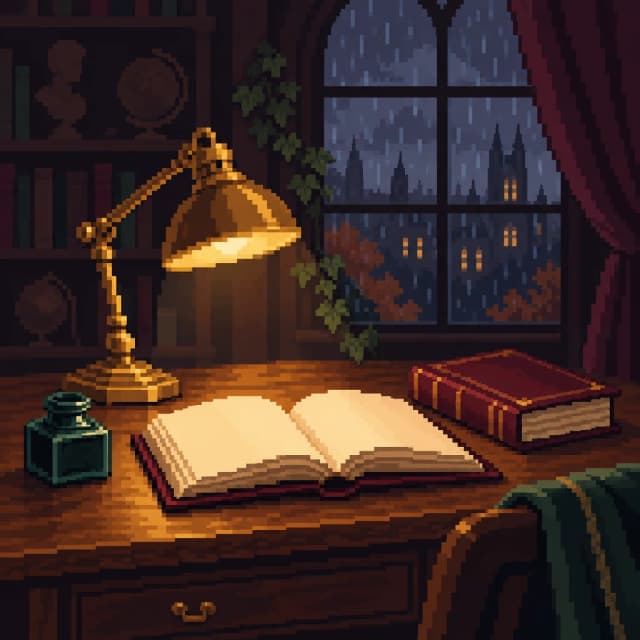
Dark academia pixel art works best when a bookish subject has a clear shape: a brass lamp over a notebook, a ladder against library shelves, or a glowing bookshop window in the rain. Use a small cast of objects, deep colors and one warm light source. These twelve ideas give you a starting prompt and a composition choice, so your scene has something to color beyond a wall of tiny brown details.
What makes a dark academia scene readable in pixels?
The mood comes from studying, reading and the places that hold books. A chipped desk, a library aisle or an old map can do the work. You don't need a castle, three scholars and an entire storm to make a picture feel bookish.
Start with one recognizable object and one source of light. Give the notebook a pale page edge, the lamp a clear shade, or the window a bright frame. Dark green beside dark brown may feel right on a palette, yet the objects can merge when you see the image small.
Try this scene recipe:
- Subject. Name the thing you want to notice first: a desk lamp, a library ladder or a stack of books.
- Supporting object. Add one item that tells a story, such as an ink bottle or a folded coat.
- Setting. Pick a desk, window, shelf or doorway, rather than describing a whole building.
- Lighting. Choose lamplight, candlelight or a pale window. Leave some areas quiet.
The prompts below use that recipe. They're untested suggestions, so treat them as starting points. Our pixel art prompt guide explains how to simplify a prompt when its first result feels crowded.
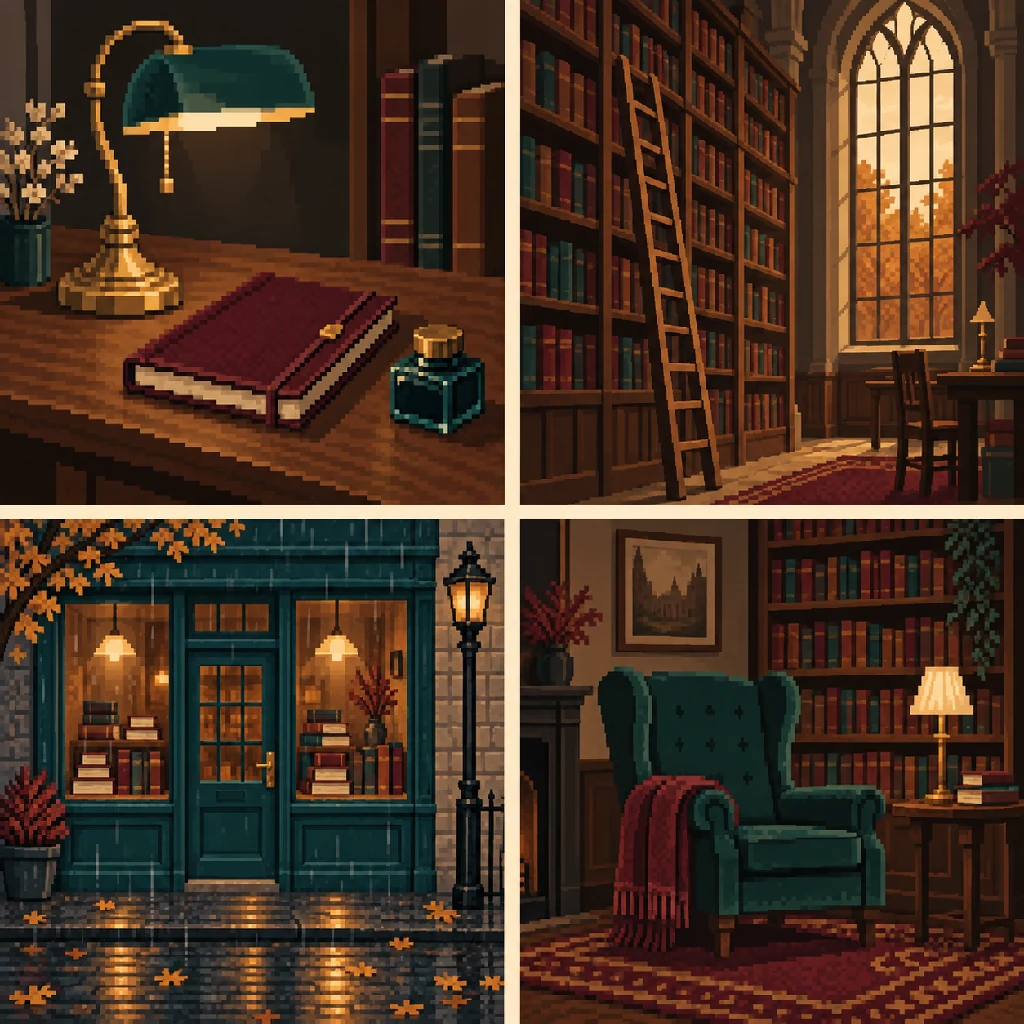
The cover and these four concepts are AI-generated editorial illustrations made outside Pixfun. They show possible moods and compositions, rather than tested app results.
Which desk and study ideas should I try first?
Desk scenes give you large, familiar shapes to work with. Keep the viewpoint close enough that the main object fills a useful part of the picture. A room seen from far away turns your carefully described ink bottle into a speck.
1. The last lamp in the study
Prompt: “A brass desk lamp lighting one closed burgundy notebook and a teal ink bottle on a walnut desk, dark shelves behind, chunky pixel shapes.”
Let the shade and notebook carry the scene. Ask for closed pages if an open book keeps becoming an uncertain cream shape. A few broad shelf silhouettes suggest a study without requiring dozens of individual book spines. This is a good first idea because its focal objects don't depend on faces or tiny lettering.
2. A pressed leaf between pages
Prompt: “An open cream book with one copper autumn leaf across its pages, dark green desk mat, warm light from the left, close-up pixel art.”
Use a leaf with a broad outline. A delicate fern asks the picture to preserve many thin branches, which may be lost in a small grid. Leave the pages blank; their shape matters more than their writing. The contrast between pale paper and a copper leaf gives you a clear center to color.
3. The forgotten tea beside a notebook
Prompt: “A plain cream teacup beside a closed brown notebook and one fountain pen, lamplit wooden desk, simple pixel art still life.”
Keep the cup larger than the pen. A pen can read as a simple dark diagonal, while the handle gives the cup its identity. If the scene becomes crowded, remove the saucer before adding more detail. The point is the pause between pages, with enough space around the objects to see them.
4. A globe in an afternoon study
Prompt: “An old globe on a short wooden stand beside two stacked books, pale autumn window light, deep green wall, broad pixel shapes.”
Ask for broad land shapes, rather than country names or accurate map labels. Give the globe a distinct round outline and keep its stand visible. The window can stay outside the frame; a pale patch of light is enough to suggest it. This avoids making the background compete with the globe.
Which library and bookshop scenes have strong shapes?
Use architecture as a frame for a single subject. A tall window, a ladder or a doorway makes a scene recognizable even when the shelves are simple blocks. For fuller rooms, keep the objects in separate areas instead of layering everything in the middle.
5. The library ladder
Prompt: “A wooden rolling ladder beside tall library shelves and one glowing arched window, amber and dark brown palette, clear pixel art silhouettes.”
The ladder supplies the rhythm: two long rails and a few visible rungs. Space it away from the bookcase so it doesn't disappear into the shelves. Let the books become grouped patches of color. Asking for every spine to be distinct can make the image busy without making it more convincing.
6. The rainy bookshop window
Prompt: “A small old bookshop with a teal door and two stacks of books in its warm display window, rainy evening, front view, no shop lettering, pixel art.”
A front view gives the door and window clean shapes. Keep the rain as a few lines or puddles instead of a curtain across the whole image. The bright display should be the first thing you see. Leave the sign blank; tiny text is an unreliable way to establish the setting.
7. The returns desk after closing
Prompt: “A library returns desk holding three uneven stacks of books and one shaded lamp, empty dark doorway behind, quiet evening pixel art.”
Vary the stack heights so the books don't turn into one rectangle. Keep the doorway plain and the desk edge visible. A close crop can help if the first attempt places the stacks far away. Three piles already suggest a day's reading; adding a catalog, clock and chair isn't necessary.
8. The archive cabinet
Prompt: “A small wooden archive cabinet with one open drawer and a cream index card standing inside, brass handles, warm study light, simple pixel art.”
Use the open drawer as the focal point. The other drawers can be broad repeated rectangles, with a few bright handles to separate them. Don't request readable writing on the card. Its pale shape and position tell the story. If the cabinet feels flat, change the view slightly rather than filling it with ornaments.
What can I make when I want fewer objects?
A smaller still life can carry the same atmosphere as a room. These ideas suit a session where you want a distinct subject and a quiet background. Choose one detail that feels personal, such as a bookmark color, rather than adding another shelf.
9. The book tied with ribbon
Prompt: “One worn burgundy book tied with a dark teal ribbon on a cream tabletop, a small brass key beside it, close-up pixel art.”
Keep the ribbon broad enough to cross the cover visibly. The key needs a clear loop, rather than lots of tiny teeth. A lighter tabletop gives both objects room to stand out. If the key becomes distracting, remove it; the tied book can hold the entire composition on its own.
10. The owl bookend
Prompt: “A carved wooden owl bookend holding three tall books upright, amber desk light, plain dark green background, chunky pixel art.”
Give the owl two clear eyes and a compact silhouette. It doesn't need individual feathers. Change the book heights to show that they're separate objects, and leave a gap between the owl and the edge of the picture. A simple animal shape adds character without requiring a complicated human portrait.
11. The bookmark and reading glasses
Prompt: “Round reading glasses on a closed brown book with a wide burgundy bookmark hanging over the edge, pale desk surface, top-down pixel art.”
The top-down view helps keep the glasses readable. Their loops need space, while the bookmark can be one broad strip. Avoid patterned fabric or dense page texture in the same image. You'll get more from a clear outline than from asking the generator for antique detail in every corner.
12. The chair waiting for a reader
Prompt: “An empty dark green armchair with a folded burgundy blanket beside a broad bookcase and one small reading lamp, warm evening pixel art.”
Use a close view of the chair rather than a wide room. The blanket should cross one arm or the seat, so its shape stays separate. Keep the bookcase mostly in shadow and give the lamp a small bright patch. The empty chair leaves the scene open: someone has just left, or hasn't arrived yet.
How can I generate and color one of these in Pixfun?
In Pixfun, AI Studio turns a text idea into a numbered pixel puzzle you can color by tapping its cells. Each generation costs one AI credit, takes about a minute and needs an internet connection. The examples above don't guarantee a particular result, so begin with the scene you most want to spend time coloring.
- Choose one prompt. Keep its main subject and remove details you don't care about.
- Choose a canvas. Use at least 64×64 for a clearer visual representation, or 96×96 for fuller scenes. The size options are 48×48, 64×64 and 96×96, shown as dimensions.
- Choose a style. Classic is a reasonable starting suggestion for these scenes. Noir can suit a darker mood, while Fantasy is another option for a storybook setting. These are style suggestions, not tested prompt-and-style combinations.
- Inspect the result. Look for separate objects and useful light-dark contrast. If you decide to generate a simpler version, it will cost another AI credit.
- Start coloring. Selecting a color highlights its matching cells. You can pinch to zoom, and progress auto-saves when you put the picture down.
For the broader workflow, see our AI pixel art generator guide. If your autumn mood runs toward pumpkins and playful ghosts, the Halloween pixel art ideas have a different set of scenes.
Pixfun is available now on the App Store and Google Play. Download Pixfun when you have a scene in mind. Start with one lamp and one book; the rest of the library can wait.
Frequently asked questions
What makes pixel art look like dark academia?
Books, old study spaces, warm lamps and deep brown, green or burgundy colors can give pixel art a dark academia mood. Keep one subject easy to recognize, such as a desk or library ladder. A dark palette still needs lighter shapes so the scene does not disappear into shadow.
What canvas size should I use for bookish pixel art?
In Pixfun AI Studio, choose at least 64×64 for a clearer visual representation, or 96×96 for fuller scenes. The current options are 48×48, 64×64 and 96×96. Larger scenes still benefit from a short prompt with a few clear objects rather than a long list of small details.
Have these prompts been tested in Pixfun?
These twelve prompts are suggestions, not tested Pixfun recipes. The cover and concept sheet are editorial illustrations generated outside Pixfun. Your result may differ, so inspect the subject before deciding to generate another version, which costs another AI credit.
Can I generate and color these ideas on my phone?
Yes. Pixfun AI Studio turns a text prompt into a colorable pixel puzzle in about a minute, using one AI credit per generation and an internet connection. Pixfun is available now on the App Store and Google Play. You color the resulting numbered cells by tapping them.
Can I sell artwork made from these prompts?
A prompt suggestion does not grant a commercial license for the generated image. Pixfun lets you save, print and share finished pieces personally, while commercial use of AI-generated artwork requires written permission under its Terms of Service.